Voice AI Explained
What Are Voice AI Agents and How Do They Work?
Aug 03, 2026
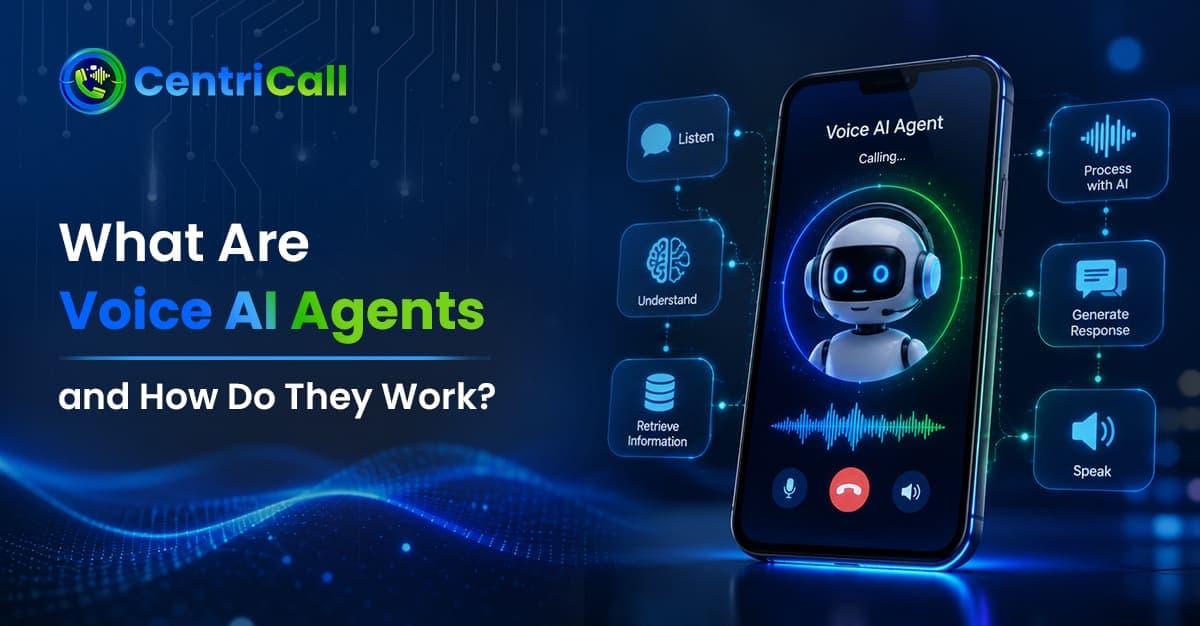
What voice AI agents are, how they work, and why businesses use them to automate phone calls, improve customer service, and lift productivity.
Voice AI Agents help businesses with phone communications. They assist customers, identify leads, and handle daily calls. These systems avoid complicated electronic menus, making interactions smoother. Voice AI Agents understand natural speech. They quickly identify a person's needs and provide an immediate response.
Voice AI Agents can do things like:
- Schedule meetings
- Check purchase details
- Update records for buyers
- Transfer important calls when needed
The value of Voice AI Agents goes beyond sounding human. A good Voice AI Agent also needs accurate company data, clear call rules, secure connections, and careful analysis. Voice AI Agents should create a direct path to a real human when conversations get emotional or complicated.
This blog post covers Voice AI Agents. It explains how they work, who uses them, and their key benefits. It also covers how to get started. And it sets out what to expect as phone automation keeps growing.
What Is an AI Voice Agent?
An AI voice agent is software that answers or places phone calls, understands natural speech, holds a two-way conversation, completes tasks such as booking appointments or updating records, and transfers to a person when needed, without menus or keypad prompts.
That last clause is what sets it apart from older automated phone systems. Callers say what they need in their own words, on inbound or outbound calls, and the agent works out the request and acts on it rather than reading a list of options at them.
- Natural conversation: callers use simple words. The software is made to understand human speech.
- Context awareness: the AI voice agent remembers facts shared earlier. This helps keep the conversation flowing smoothly.
- Task execution: the AI voice agent can schedule appointments, collect data, and check official records.
- Flexible routing: calls go to the right departments based on the caller's needs or urgency level.
- Recorded outcomes: summaries and action steps are created for each interaction.
Centricall creates digital representatives by using companies' scripts, rules, and tech setups. Centricall tunes the software to your goals. That is what keeps each call accurate and under control. The AI voice agent maintains accuracy by following the company's escalation protocols.
How Do Voice AI Agents Work?
Voice AI Agents continuously listen, interpret, decide, act, and speak. Telephony connects the call. Speech recognition turns words into text. Connected tools carry out the actions they are allowed to. Speech generation then delivers the answer.
| Voice AI Stage | What Happens | Business Outcome |
|---|---|---|
| Call connection | The agent answers an inbound call or places an approved outbound call. | Customers receive faster assistance without waiting for an available employee. |
| Speech recognition | The caller's spoken words are converted into text for immediate processing. | The system understands natural requests without requiring keypad selections. |
| Intent detection | The agent identifies whether the caller needs support, booking, information, or routing. | Each conversation follows the most relevant call path. |
| Context review | Approved business information and earlier caller responses guide the next answer. | Callers receive consistent responses without repeating information. |
| Business action | Connected systems check availability, retrieve records, update details, or create tasks. | Routine work is completed during the conversation. |
| Spoken response | The selected answer is delivered using the configured voice, pace, and tone. | Conversations remain clear, natural, and aligned with the brand. |
| Call documentation | The system records the transcript, summary, outcome, and required follow-up. | Employees receive organized information for reporting and future action. |
Centricall connects this cycle to your business systems. The agent can answer, act, and record the result. It brings in an employee when a call needs human judgment.
What Are the Key Benefits of AI Voice Agents?
The Key Benefits of AI Voice Agents are easy to list. You get round-the-clock cover, faster answers, and steady service. You also get less manual work, better records, more languages, and room for more calls.
- Always available: customers receive help after hours.
- Faster service: routine requests are handled without long queues.
- Consistent answers: approved information reduces variation across teams.
- Higher capacity: multiple calls can be handled during peak periods.
- Less repetitive work: employees spend less time collecting basic details.
- Better records: transcripts, summaries, and outcomes are stored automatically.
- Stronger follow-up: calls can trigger CRM tasks, reminders, or alerts.
Centricall points these benefits at real outcomes. That means booked appointments, qualified inquiries, and resolved requests. It also means accurate records, prompt follow-ups, and the right transfers to your team.
Who Uses AI Voice Agents?
Businesses that receive many inquiries, or contacts after working hours, use these tools most often. Common uses are simple. Book a meeting. Update an order. Score a new lead. Keep the conversation moving. These functions work because the system organizes data effectively.
- Healthcare providers: appointment scheduling, reminder calls, intake details, and routing for clinics and practices.
- Legal firms: checking the suitability of people seeking legal help, booking consultations, and handling urgent calls for law firms.
- Real estate teams: property questions, buyer qualification, and viewing appointments for property teams.
- E-commerce businesses: order status changes, returns, exchanges, and shipping questions for online stores.
- Home services: accepting job requests, booking time slots, and dispatch alerts for field service teams.
- Hospitality providers: room bookings, changes to reservations, and guest assistance for hotels and venues.
- Recruitment teams: screening job applicants and scheduling interviews for hiring teams.
- Logistics companies: questions about items in transit and transport coordination for logistics operators.
Centricall modifies every agent to fit the specific work patterns of an industry. This modification allows for:
- Entering information
- Checking if callers are suitable
- Changing status for purchases
- Requesting bookings
- Evaluating job applicants
- Asking sales questions
Centricall ensures each interaction is handled with precision. Every agent is designed to follow the logic of the specific field.
What Defines the Best Voice AI Agents for Customer Service?
The Best Voice AI Agents for Customer Service are judged on five things. Are they accurate? Do they finish the task? Is the data connected? Do they cope with odd cases? And do they hand over to a person when they should?
- Fast responses: long pauses can make conversations feel broken.
- Accurate understanding: names, dates, numbers, and requests must be captured correctly.
- Reliable knowledge: answers should use approved business information.
- Useful integrations: authorized systems should update without duplicate work.
- Human handoff: callers need an employee when issues become sensitive or unclear.
- Practical reporting: managers need transcripts, outcomes, transfers, and completion rates.
- Controlled access: integrations should reveal only the information needed for each task.
Centricall combines custom call design, integrations, testing, and analytics. We review every agent after launch. That way you can judge quality by the work it completes, not by how the voice sounds.
How Should AI Voice Agent Implementation Begin?
AI Voice Agent implementation should begin with one defined call process. Businesses must identify the caller's needs, permitted information, approved actions, and transfer conditions.
- Choose one workflow: begin with booking, qualification, or order updates.
- Define the outcome: decide whether the call creates a record, booking, transfer, or follow-up.
- Map the conversation: document questions, required details, exceptions, and escalation points.
- Prepare knowledge: review services, policies, hours, pricing, and standard answers.
- Connect systems carefully: limit access to the CRM, calendar, or database.
- Test difficult calls: include interruptions, unclear speech, wrong information, and frustrated callers.
- Launch in stages: monitor a limited call group before expanding.
- Track useful metrics: measure completion, accuracy, transfers, and unresolved requests.
Centricall guides the whole rollout. We start with discovery and call mapping, then integration and testing. After launch we read the transcripts and tune the agent on real calls.
What Will Shape the Future of AI Voice Agents?
The Future of AI Voice Agents points in a few clear directions. Agents will take deeper actions and work across more channels. They will speak more languages, report more clearly, and give you tighter control over customer data.
- Cross-channel continuity: context may follow calls, messages, email, and chat.
- Specialized routing: one agent may identify requests before connecting specialists.
- Deeper actions: agents will complete multistep processes through connected tools.
- Live monitoring: managers will see active calls and recurring issues.
- Improved language support: pronunciation, pacing, and accent handling will advance.
- Clearer governance: access rules, disclosures, data handling, and accountability will matter more.
Centricall supports this shift end to end. That covers inbound and outbound calling, multilingual service, and connected actions. It also covers call intelligence, human handoffs, and steady improvement.
How Can Centricall Turn More Calls Into Opportunities?
A voice agent earns its place by moving calls forward. That might be a booked appointment or a qualified inquiry. It might be a completed request, an updated record, or a quick transfer. Centricall builds custom Voice AI Agents around your business. Each one gets its own scripts, languages, and escalation rules. CRM sync, call summaries, and analytics come as standard. Its managed approach covers discovery, design, integration, testing, deployment, and review.
Contact Centricall to build Voice AI Agents for your business. They answer more calls and complete routine tasks. Every conversation ends in a clear action.
Voice AI automation explained: the vocabulary, and what it hides
Conversational AI voice agents, AI voice bots, AI voice assistants: the terms get used interchangeably and they should not be. AI powered voice assistants in the consumer sense wait for a command and answer it, one turn at a time. Agentic voice AI is the newer idea and the one this article is really about: a system that holds a goal across a whole conversation, asks its own questions, uses tools, and finishes a task. That distinction is most of how voice AI agents work, and it is why a voice AI technology overview that opens with speech recognition tends to describe the least interesting layer at the greatest length.
What is voice recognition in AI, then, if it is not the interesting part? It is the front door: turning audio into text the rest of the system can reason over. Necessary, largely solved, and no more the essence of an agent than a keyboard is the essence of a word processor. The benefits of voice AI agents come from what happens after the words are understood, in the calendar that gets checked, the record that gets written, and the transfer that arrives with context attached. An AI voice agent agency that talks only about voice quality is selling you the most commoditised component in the stack.
FAQs
Can voice agents understand natural conversation?
- Yes. Properly designed agents can understand everyday speech, follow context, manage interruptions, and respond to the latest request. Performance depends on audio quality, knowledge, testing, and configuration.
Can an AI voice agent connect with a CRM?
- Yes. Approved integrations can create contacts, update records, add notes, log outcomes, trigger follow-ups, and retrieve authorized customer information during calls.
Can voice agents make outbound calls?
- Yes. They can manage reminders, confirmations, qualification, payment outreach, surveys, and follow-up campaigns when configured according to applicable consent and calling requirements.
Do voice agents replace customer service teams?
- No. They handle repetitive, structured calls, while employees manage exceptions, sensitive situations, complex decisions, and conversations requiring personal judgment.
When should a voice agent transfer a call?
- A transfer should occur when the caller requests a person, the agent lacks confidence, the issue becomes sensitive, or the action falls outside approved limits.