Analytics & Insights
Voice Agent Analytics and Call Sentiment Analysis: What to Measure and How to Compare Vendors
Nov 2, 2026
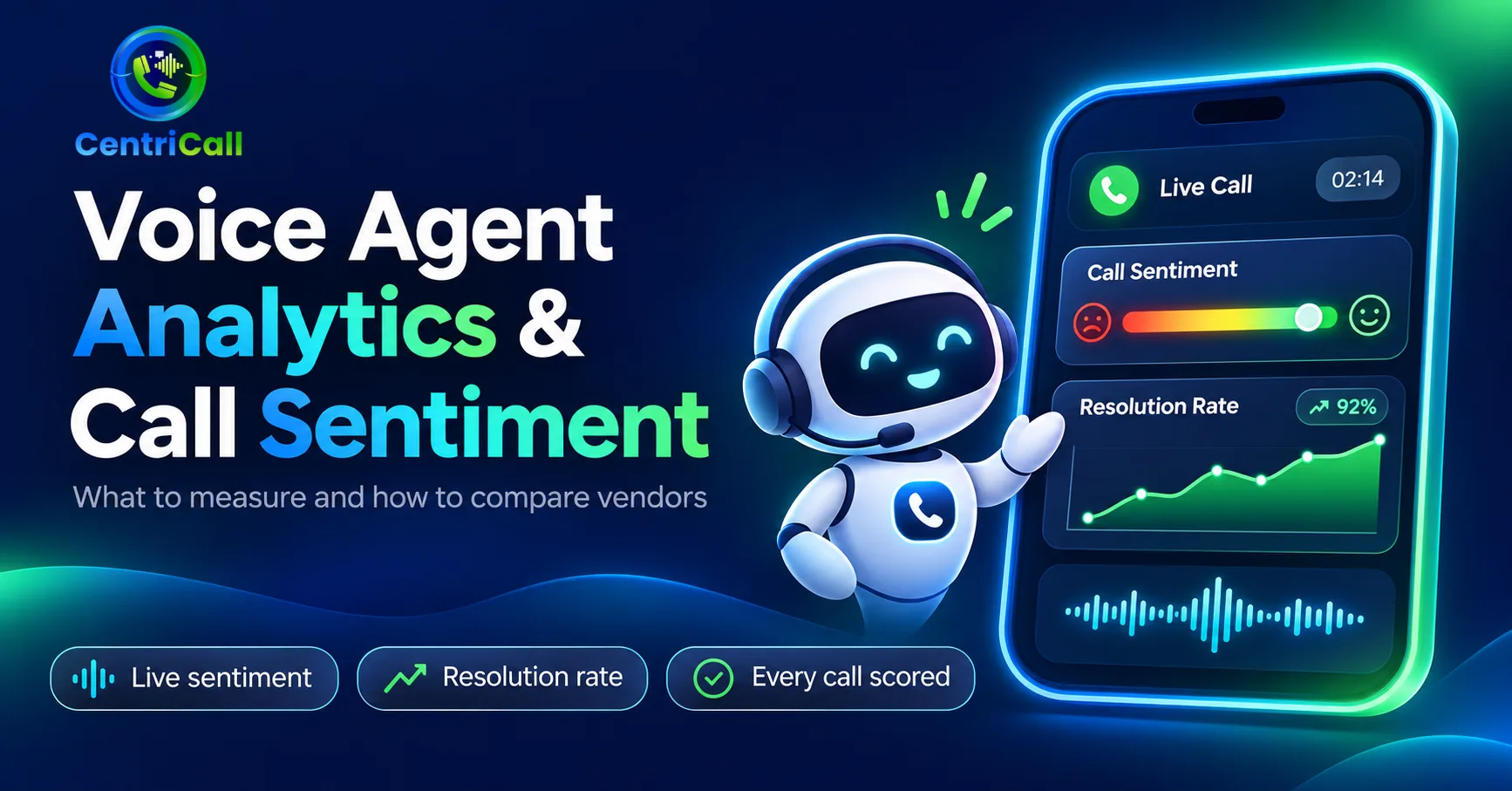
What voice agent analytics should report, how call sentiment analysis is scored, and the questions to ask before you buy AI call analytics from any vendor.
Most teams that buy a voice agent start by asking whether it answers the phone. Six weeks later the question changes to whether it is working, and the honest answer depends on what you can measure. AI call analytics is the layer that turns thousands of conversations into figures a manager can act on, and the quality of that layer varies far more between vendors than the voice does.
What voice agent analytics should tell you
A dashboard that shows total calls and average duration is a counter, not analytics. Voice agent analytics earns its name when it answers decisions: do we need more cover on Monday mornings, which call types still reach a person, and is a script change making callers happier or angrier.
- Volume by hour and day: shows when callers actually ring, including the after-hours demand a human team never saw.
- Resolution and hand-off rate: the share of calls the agent completed against the share passed to a person, split by topic.
- Reasons for calling: intent groupings built from transcripts, so you learn that a third of calls are about one thing you could fix upstream.
- Outcomes: booked, qualified, transferred, abandoned. A call without an outcome is a cost with no result attached.
- Sentiment: how callers felt, by topic and over time, so quality is visible and not guessed.
If you want the wider list of operating figures, our guide to measuring an AI voice agent covers the metrics that matter and the ones that flatter.
How call sentiment analysis works
Voice call sentiment analysis reads a conversation as it happens. The call is transcribed, each turn is scored for tone, word choice and intent, and the scores build into a running reading of how the caller feels. The point of doing it live is that the agent can act: soften its approach, prioritise the call, or warm-transfer to a person while the caller is still on the line.
Afterwards, the same scores roll up by topic and outcome. That is where sentiment analysis in a call center earns its keep, because the pattern is invisible call by call. Seeing that billing questions end unhappily twice as often as booking questions tells you where to write a better answer.
Treat the score as a strong directional signal, not a clinical measurement of any single moment. It is most reliable in aggregate and most useful for catching at-risk calls early. For the definition and the underlying method, see what customer sentiment analysis AI is and how it works.
Live scoring against after-the-call scoring
| Scored live on the call | Scored after the call | |
|---|---|---|
| When you learn about a problem | While the caller is still on the line | Hours or days later, in a report |
| What you can do about it | Escalate, change approach, transfer | Call the customer back, change the script |
| Coverage | Every call | Every call, or a sample if scoring is manual |
| Best for | Rescuing a call and routing urgent ones | Trends, training and process fixes |
How to compare AI call analytics vendors
Analytics is often sold as a tier, an add-on or a separate product, so the same words can mean different things on two pricing pages. As one example, JustCall's published pricing lists sentiment analysis on its Pro Plus and SalesPro plans and not on Team or Pro, and sells its AI voice agent as an add-on with volume discounts down to $0.15 per minute (read from justcall.io/pricing on November 2, 2026). Neither choice is wrong. It simply means you should check which tier unlocks the feature you are buying the product for.
- Is sentiment live or retrospective?: Live scoring can change a call. Retrospective scoring can only describe it.
- Does it cover every call?: A sample hides the quiet dissatisfaction that costs you customers.
- Which plan unlocks it?: Read the tier table, not the feature page.
- Does the analytics sit with the recording?: A flagged call should be one click from its transcript and summary.
- Can you export it?: Your data should reach your CRM and reporting tools without a manual step.
With Centricall, call analytics and sentiment scoring are part of the voice agent rather than a separate product, and every call is recorded, transcribed and summarised in the same record.
Turning the numbers into changes
- Start with one call type: pick the call that happens most often and read ten of its summaries before looking at a chart.
- Set a threshold for escalation: decide which sentiment drop should trigger a transfer, and review the first week of triggers by hand.
- Change one thing at a time: edit one script or answer, then compare resolution and sentiment for that topic over the next fortnight.
- Review monthly: the reasons people call change with season, pricing and news, and the dashboard will show it first.
FAQs
What is voice agent analytics?
- Voice agent analytics is reporting on what an AI voice agent does across its calls: volume, resolution and hand-off rates, why people called, how they felt and what happened next. It turns each conversation into data you can act on.
Can AI track customer sentiment during calls?
- Yes. The agent scores sentiment continuously while the call is live, reading tone, word choice and intent. If frustration crosses a threshold you set, it can change approach or transfer to a person, and the score is stored with the call for trend reporting.
How do companies detect customer sentiment during a live call using AI?
- The call is transcribed as it happens, each turn is scored for tone, word choice and intent, and rules act on the running score, for example by escalating when frustration persists. Afterwards the scores roll up by topic and outcome.
What is sentiment analysis in a call center?
- It is scoring how customers feel on calls, then using the pattern to fix scripts, train staff and catch unhappy callers early. AI makes it possible to score every call, where manual QA usually reviews a small sample.
How accurate is call sentiment analysis?
- It is a strong directional signal, most reliable in aggregate. Use it to find at-risk calls and track trends, and listen to the recording before drawing conclusions about any single call.
What is the difference between AI call analytics and call summaries?
- A call summary describes one call. AI call analytics measures all of them together, showing volume, resolution, reasons for calling and sentiment trends. The best tools keep both in the same record.