AI & Customer Experience
What Is Customer Sentiment Analysis AI and How Does It Work?
Oct 5, 2026
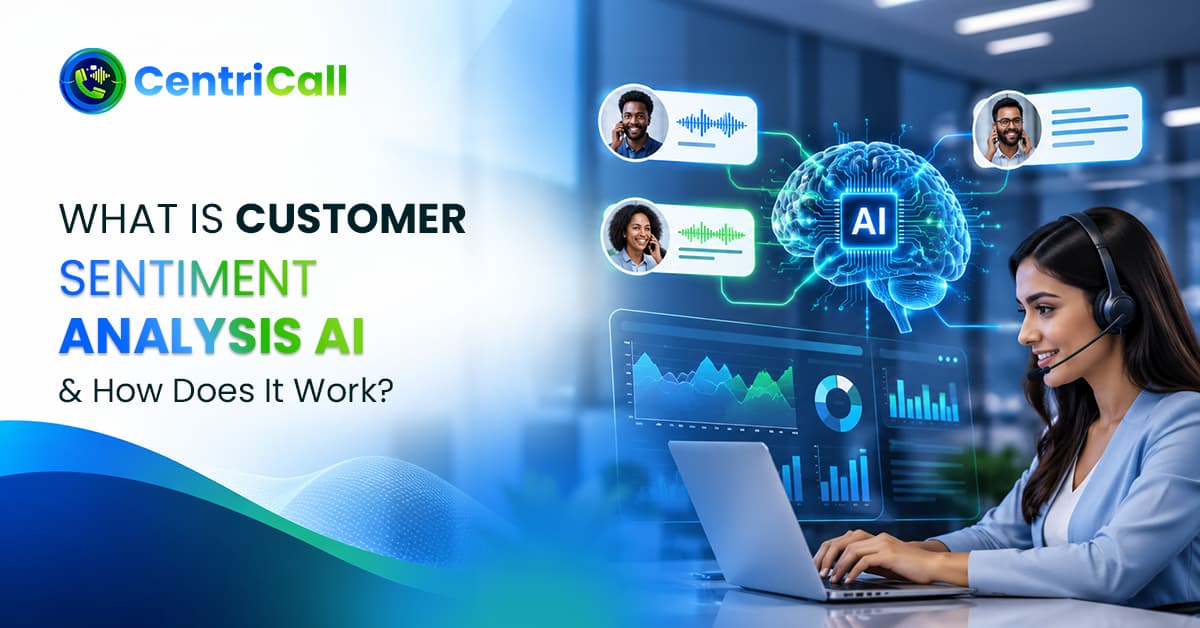
Customer sentiment analysis AI is a technology that listens to phone calls in real time and uses AI to analyze the content of the calls to score the caller's sentiment. It can detect frustration in real time and allow for intervention with those callers while they are still on the phone.
Customer service departments have always looked at call sentiment, though often only after the fact, by listening to recorded calls. One of the main drawbacks of such technology is that the customer has already hung up, leaving no chance to fix the issues encountered during the call.
This blog explains how customer sentiment analysis works, why it matters for your company's revenue and retention, how it compares to manually reviewing calls, and the best options available to purchase today for your customer service department.
What is Sentiment Analysis?
Sentiment analysis is the broader field of study that this software is built on. At its core, it's the process of using computational methods to determine whether a piece of communication (spoken or written) expresses a positive, negative, or neutral sentiment. Sentiment analysis isn't new. It's been used for years to analyze product reviews, social media posts, and survey responses.
What is Customer Sentiment Analysis AI Software?
Customer sentiment analysis AI software is a technology that analyzes a phone call to determine the feelings of the person on the other end of the call. By analyzing their words and the tone, pace, pauses, hesitations, and emphasis of their voice, it can determine the feelings of the person on the other end of the call. This can help companies and support teams to better understand the needs and emotions of their callers.
- Word meaning: The AI analyzes the words that are spoken by the callers and determines if they are positive, negative, neutral, or uncertain about something.
- Voice cues: The AI analyzes the voice of the callers to determine feelings and emotions beyond the words that are spoken. This can include their tone, pace, silence between words, overlap between the caller and the agent, and the amount of hesitation between words in the conversation.
- Live scoring: Sentiment is analyzed while the caller is on the call with the agent. The AI will provide a sentiment score throughout the call.
- Context tracking: The AI tracks sentiment throughout the duration of the call between the caller and the agent.
- Action value: The AI will provide companies and their employees with the value to take action throughout the call to improve the sentiment of the caller.
- Pattern visibility: Managers can use the AI to gain visibility into recurring feelings and emotions throughout the calls between their employees and callers to improve their company’s overall customer service and support experience.
What Are the Types of AI Customer Sentiment Analysis?
There are four Types of AI Customer Sentiment Analysis: polarity, emotion detection, aspect analysis, and voice and tone analysis. They each interpret the emotions of customers differently, spanning from a rudimentary positive or negative rating to the granular reason for a customer's specific emotional response during a live call.
None of these provides the whole picture. Most platforms mix two or more of them depending on what the team wants to learn, and how quickly it wants to learn it.
Polarity-Based Sentiment Analysis
Polarity-based is the most basic type. A call is classified as positive, negative, or neutral with a corresponding score for sentiment strength. This helps managers get a quick overview of how customers feel, even across thousands of calls.
- What it catches: A statement or whole call being classified as positive, negative, or neutral.
- Best for: Organizations that receive high call volumes and require a rapid, high-level overview of customer mood.
- Main limit: It can alert you to an angry caller, but not the reason for it. It is thus most effective when used in conjunction with other types.
Emotion Detection
Identifying specific feelings moves beyond the simple categories of good or bad. Emotion detection captures particular states like irritation, worry, uncertainty, or comfort. This distinction remains crucial because an individual expressing rage and an individual expressing lack of understanding require very different responses from the working professional.
- What it detects: Particular internal states including annoyance, rage, nervousness, happiness, or uncertainty, identified through the combination of vocabulary selection and sound characteristics.
- Why it matters: Working positions allow individuals to modify their behavior so that the method matches the feeling. Speaking with less speed assists when uncertainty exists, while expressing regret is utilized when rage is present.
- Main limit: Overlapping of various feelings occurs, and these states fluctuate while a conversation continues. Because a single measurement lacks accuracy, the numerical ratings are viewed as general patterns.
Aspect-Based Sentiment Analysis
Aspect-based analysis connects emotional reactions to a particular subject within the verbal exchange. An individual who places a call might feel satisfaction regarding the service representative yet remain frustrated concerning financial invoicing.
- Elements discovered: Emotional attitudes directed toward specific subjects, including financial costs, transportation of goods, item excellence, duration of waiting, or representative conduct.
- Significance of the approach: Organizational groups are enabled to perceive which specific portion of the journey caused the emotional response. The root problem can be addressed by the staff instead of merely treating the external sign.
- Ideal application: Working positions in manufacturing departments, financial departments, and operational procedure units that search for repetitive grievances occurring throughout numerous telephonic interactions.
Voice and Tone-Based Sentiment Analysis
This specific category holds the greatest significance regarding voice-based assistance. This approach does not depend solely upon the written record of words. This method interprets the manner in which speech was delivered, which includes the velocity of talking, loudness, intervals of silence, disruptions, and moments of uncertainty
- What it detects: The emotional quality of voice, speed, moments of silence, instances where speakers talk at the same time, and signs of doubt which a documented transcription fails to display.
- Why it matters: Hidden irony and increasing levels of annoyance are identified by this system even though text-based evaluation usually fails to notice such patterns. Because these subtle vocal cues are recognized, the possibility for immediate human involvement is created.
- Best for: The active observation of telephone conversations and the immediate elevation of urgent matters within communication hubs and automated vocal systems.
Intent-Based Sentiment Analysis
Analysis of intent connects the feelings of individuals with the specific actions those individuals seek to perform, including instances where someone might wish to terminate a service, voice a grievance, acquire a product, or seek assistance.
- What it detects: The probable objective of the participant, such as seeking a service improvement, lodging a formal protest, or asking for technical guidance, is identified by this method while simultaneously measuring the internal temperament of the individual.
- Why it matters: Significant indicators of client departure and opportunities for new transactions are highlighted when the emotional disposition of the consumer is linked with the future steps that the consumer intends to take.
- Best for: Teams focused on keeping existing clients and those providing assistance for transactions utilize this tool when the teams must determine which specific communications require immediate intervention.
How Does AI Analyze Customer Sentiment on a Call?
Sentiment analysis on a live call runs through a fast, continuous pipeline. Understanding the mechanics helps explain why real-time detection is possible at all.
From Speech to Signal — Transcription and Tone Detection
Audio is converted to text in near real time, but the transcript is only half the input. Vocal cues speaking speed, volume changes, pauses before answering, and interruptions are layered on top to capture emotional context that words alone miss.
Real-Time Scoring During Live Conversations
Once speech becomes a signal, the system assigns a running sentiment score instead of waiting for the call to end. This gives agents an alert about what is happening, rather than only a report about what happened.
The pipeline generally follows four steps:
- Capture: Audio streams from the live call as it happens, with no delay between speech and processing.
- Transcribe: Speech-to-text converts words in real time while preserving timing and speaker turns.
- Score: Tone, pacing, and word choice are combined into a live sentiment score that updates continuously.
- Sync: Scores and flags push into the CRM or dashboard instantly, visible to supervisors and agents alike.
Ways To Use AI for Sentiment Analysis
Customer Sentiment Analysis AI isn't limited to one department or use case. There are Ways To Use AI for Sentiment Analysis, and it can be applied across nearly every point of customer contact.
- Live call monitoring: Tracks emotional shifts in real time so agents can adjust tone or escalate issues immediately.
- Post-call quality assurance: Reviews completed calls to flag coaching opportunities and identify recurring customer pain points.
- Customer feedback analysis: Scans survey responses and reviews to detect broader satisfaction trends across large data sets.
- Churn prediction: Identifies frustrated or disengaged customers early, giving teams a chance to intervene before they leave.
- Agent performance coaching: Highlights which agents consistently de-escalate tension versus those who need additional training support.
Why Customer Sentiment Analysis AI Matters for Your Business?
Sentiment data only creates value if it changes what happens next. Real-time detection turns a lagging indicator into an active lever for saving accounts and coaching agents.
Spotting Frustrated Callers Before They Hang Up
When frustration is flagged mid-call, a supervisor can join, a script can change, or the call can be escalated, all before the caller decides it isn't worth the effort to continue the conversation.
- Reduce churn: Ensure that a customer's frustration is caught and resolved in time so that they don't decide to disconnect their account with your business.
- Speed up escalations: Ensure that your difficult and frustrating calls are automatically routed to senior agents.
- Improve coaching accuracy: Provide your managers with data that indicates when your callers began to exhibit frustration in their voice.
- Protect your VIP accounts: Ensure that any significant issues from your VIP accounts are flagged for special attention by your agents.
- Standardize quality checks: Ensure that your call scoring is applied equally to every call that you take.
- Support compliance reviews: Automatically flag any calls where your agents and customers get into significant disputes.
Benefits of AI Sentiment Analysis
The Benefits of AI Sentiment Analysis go well beyond simply knowing how customers feel.
- Faster issue resolution: Flags frustrated customers immediately, allowing teams to intervene before problems escalate further.
- Improved agent training: Highlights specific conversation moments that led to positive or negative outcomes for coaching.
- Better customer retention: Identifies at-risk customers early, giving businesses a chance to fix issues proactively.
- Data-driven decisions: Replaces guesswork with measurable emotional insights across thousands of customer interactions.
- Scalable quality assurance: Reviews every single call instead of just a small manual sample, improving overall coverage.
AI Sentiment Analysis vs. Manual Call Review: At a Glance
The biggest difference is coverage: AI reviews every call, while manual review checks only a handful. That gap compounds as call volume grows.
| Factor | Customer Sentiment Analysis AI | Manual Call Review |
|---|---|---|
| Call coverage | 100% of calls | A small sample |
| Speed | Real time | Hours or days later |
| Consistency | Uniform scoring | Varies by reviewer |
| Cost to scale | Flat as volume grows | Rises with headcount |
| Acting mid-call | Yes | No |
Key Features to Look for in a Sentiment Analysis Platform
Not every sentiment tool operates in real time or integrates cleanly into your workflow. When choosing your company, there are some core capabilities that any good sentiment analysis tool should offer:
- Real-time scoring: Real-time scoring of the conversation during the call, not just in a summary report of the conversation afterward.
- CRM sync: The ability of the sentiment tool to automatically sync with the customer relationship management software that your company currently uses.
- Call transcription: The sentiment tool should also automatically transcribe the call word-for-word so that the sentiment score that is recorded can be associated with specific words and statements in the conversation.
- Escalation rules: Escalation rules should be present so that the sentiment tool can automatically route any call that crosses a defined risk threshold.
- Language support: Ensure that the tool supports the languages that are actually used in the calls made by your company, and that the sentiment scoring is accurate for those languages.
How Centricall AI Delivers Real-Time Call Sentiment?
Centricall AI applies this approach inside a working voice agent, scoring sentiment on every call as it happens rather than sampling a fraction after the fact. Each call is captured, transcribed, and scored live, with sentiment data synced directly to the CRM alongside full transcripts and call summaries.
That combination live scoring, complete transcripts, and automatic CRM sync - gives teams a single source of truth for what happened on a call and how the customer felt about it. If your team is weighing whether real-time sentiment tracking fits your call operations, a discovery call is a practical next step to see it against your own call data.
See how Customer Sentiment Analysis AI works on live calls with Centricall AI—book a discovery call and map the signals, escalations, and CRM actions that matter to your team.
FAQs
Is customer sentiment analysis AI accurate?
- Accuracy depends on audio quality and the clarity of what's being measured. With clean call audio and a well-defined scoring scope, modern sentiment AI performs reliably, though it works best paired with human oversight for edge cases.
Can AI detect sentiment from voice, not just text?
- Yes. Vocal cues like tone, pace, and pauses carry emotional signals that transcript text alone doesn't capture, which is why voice-based sentiment analysis reads sarcasm, hesitation, and rising frustration more accurately than text-only scoring.
How does real-time sentiment analysis help during a live call?
- It lets supervisors or automated rules intervene while the caller is still connected, joining the call, adjusting routing, or triggering an escalation instead of discovering frustration only after the customer has already hung up
Does sentiment analysis AI work for multilingual calls?
- Platforms built for multilingual support can detect language automatically and apply sentiment scoring across languages, though accuracy varies by provider and should be confirmed for the specific languages your call volume covers.
How is call sentiment data stored and kept secure?
- Sentiment scores, recordings, and transcripts are typically stored with access controls and defined retention periods, similar to other sensitive call center data, so it's worth confirming a provider's specific security and retention policies before adopting one.