Customer Experience
AI Platforms That Reduce the Red Blinking Lights on Dealership Phone Systems
Oct 12, 2026
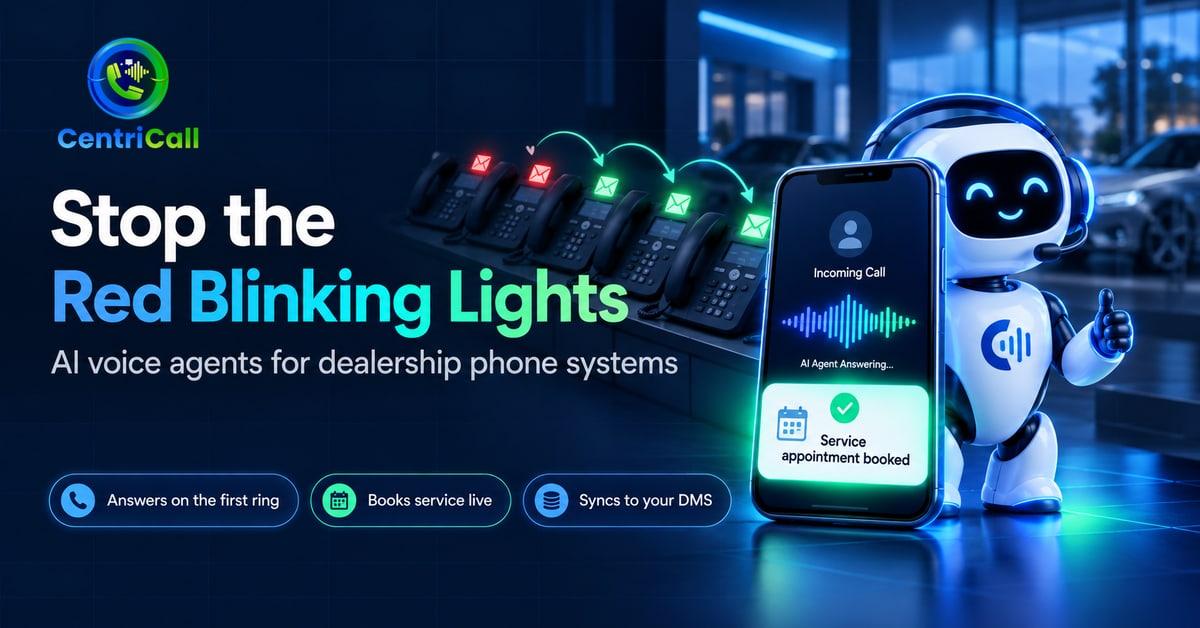
A red blinking light on a dealership phone is a call nobody answered. Here's which kinds of AI platform actually clear it, and how to choose one.
Walk through a dealership at eight in the morning and count the lights. One on the service desk, one on the sales manager's phone, another at the parts counter. Each one is a customer who rang, waited, and gave up long enough to talk to a machine. Most of them didn't want a voicemail box. They wanted an appointment, an answer or a person.
No software switches the lamp off by itself, because the lamp is a symptom. It lights when a call goes unanswered and someone leaves a message. So the platforms worth buying are the ones that stop the call getting that far, and make sure whatever's left is a tracked task and not a blinking handset.
What a blinking light really tells you
A message-waiting light is the one metric a dealership phone system shows without anyone asking. It says three things: a call went unanswered, the caller cared enough to leave a message, and nobody has returned it yet. What it doesn't show is how many callers hung up without leaving anything, and that's usually the bigger group.
Why the lights blink
A dealership runs two phone lines with completely different rhythms. The service drive floods between seven and ten in the morning while advisors are with customers at the counter. The sales desk spikes whenever a listing goes live or a campaign lands. The pattern is structural, so hiring one more person rarely fixes it.
- Service rush: calls arrive in a burst while every advisor is already face to face with a customer.
- Floor traffic: salespeople will always take the customer standing in front of them over a ringing phone.
- After hours: buyers who find a listing at ten at night ring a line nobody is staffing.
- Overflow: when every line is busy, the next caller goes straight to voicemail.
- Unowned messages: a voicemail left on a shared extension belongs to everyone, so nobody returns it.
One morning on the service line
Picture the hour before the shop opens. Customers are ringing to book a repair, ask if their vehicle is ready, or confirm a time. Two advisors are at the counter, a third is on a call about a warranty question, and the phone keeps going. By the time the first advisor looks up, there are three lit handsets and no telling how many callers hung up in silence.
None of those calls were complicated. A booking, a status check and a confirmation need an answer and a calendar, not a service manager. That's the pattern to notice. The calls that light the handset are mostly the simple ones, which is exactly the work a voice agent is built to finish.
The five kinds of AI platform that claim to help
Most products pitched at this problem fall into one of five types. Only one removes the cause. The others are useful for what they actually do, which isn't always what they're marketed as.
1. Voicemail transcription and visual voicemail
These turn a message into text and push it to an inbox or phone. That makes a voicemail faster to read, which has real value. But the caller still waited, still spoke to a machine, and the lamp still lit.
2. Call tracking and conversation analytics
These record and score calls so you can see how many you missed and which ads produced them. They're good at sizing the problem. They don't answer a single call.
3. Website chat and messaging assistants
A chatbot catches the shopper who's already on your site. It does nothing for the caller dialing the service line at twenty to eight, so it can't be your main answer to a phone problem.
4. AI voice agents
A voice agent answers the ringing line, works out whether the caller wants sales, service or parts, and acts. It books the service appointment, qualifies the inquiry, answers a parts question, or transfers with a summary. It's the only type that stops the call becoming a voicemail.
5. Outsourced or AI-assisted BDC services
A managed BDC takes overflow and follow-up off your team. It can work well, but it's priced by the hour or the call and still has finite capacity at a peak. Many dealers run one alongside an agent rather than instead of one.
| Platform type | Answers the call? | Reduces blinking lights? | Best use |
|---|---|---|---|
| Voicemail transcription | No | No, it speeds up reading them | Making messages easier to triage |
| Call tracking and analytics | No | No, it measures them | Sizing the problem and ad attribution |
| Chat and messaging | No | No | Website shoppers |
| AI voice agent | Yes | Yes, at the source | Main line, service drive, after hours |
| Managed BDC | Yes, within staffing | Partly | Outbound follow-up and overflow |
Mistakes people make trying to fix it
- Treating transcription as the fix: a voicemail that's easier to read is still a customer who wasn't answered.
- Buying a dashboard first: knowing how many calls you miss is useful, but it doesn't return a single one.
- Routing every call to one extension: piling the problem onto one person just moves where the light blinks.
- Hiring for the peak: staffing the 7 to 10 a.m. rush means paying people who sit idle the rest of the day.
- Ignoring after hours: evening and weekend callers are often the most motivated, and nobody's watching those lights.
- Leaving callbacks unowned: if nobody is named to return a message, nobody returns it.
What to check before you buy
Demos all sound good on a clean call. These checks separate a platform that clears the lights from one that just moves them.
| Capability | Why it matters on a dealership line | Question to ask |
|---|---|---|
| Answers on the first ring | A caller who waits is a caller who hangs up | Is there any queue or delay before it picks up? |
| Unlimited simultaneous calls | The 7 to 10 a.m. rush is many calls at once | What happens when ten people call in the same minute? |
| Books into your service schedule | A taken message still leaves the work | Does it write to an open bay, or just email a request? |
| Writes to your CRM or DMS | Otherwise the record is a sticky note | Which systems does it update, and in real time? |
| Transfers with context | Callers hate repeating themselves | Does the person see a summary before they answer? |
| Fallback for what it cannot resolve | Some calls need a person | Does an unresolved call become a task with an owner? |
How a voice agent clears the lights
- It answers: your existing number rings through to the agent, so nothing changes for callers.
- It works out the need: sales, service, parts or something else, from the caller's own words and no menu.
- It acts: books a service slot, qualifies a buyer and books a test drive, or answers from your approved knowledge.
- It hands off cleanly: anything that needs a person is transferred with a summary, or logged as a task with an owner.
- It records the outcome: the transcript, summary and result go to your CRM, so the call is a record and not a message.
A sensible rollout order
Don't hand over every line on day one. Starting narrow limits the risk and gives you real calls to learn from before you widen the agent's remit.
- Start with after hours and overflow: these calls would otherwise go to voicemail, so the agent can only improve them.
- Add the service line during the morning rush: most lights come from here, and bookings are the easiest call to finish.
- Bring in sales inquiries: once you trust the booking, add qualification and test-drive scheduling, with hot leads routed to the floor.
- Review transcripts weekly: fix gaps in the knowledge base and tighten the transfer rules while volume is still low.
What it won't do
An agent isn't a salesperson. Price negotiation, a nuanced trade-in conversation and an upset long-standing customer are calls where a person should answer, and a sensible setup keeps a path to one. It also won't rewire your phone system. Whether the physical lamp on a legacy handset clears depends on how your PBX handles message indicators, so check with your phone vendor.
How to tell it's working
- Count the lights: note how many handsets are lit at opening for a week before launch, then again after.
- Track answered rate: the share of inbound calls reaching a person or an agent, split by sales and service.
- Track bookings made on the call: service and test-drive appointments created before the caller hangs up.
- Track unresolved calls: calls that became a task, and how long each waited for an owner.
Where Centricall fits
Centricall is the fourth type: an AI voice agent built for the dealership main line. It answers sales and service calls at once, books into open bays, qualifies inquiries and writes outcomes to your CRM or DMS. Plans start at $49 a month, and it covers after-hours and overflow calls too. It can place outbound follow-up as well, which we cover in our guide to AI platforms that handle both inbound calls and outbound notifications for dealerships.
FAQs
What does the red blinking light on a dealership phone mean?
- It's the message-waiting indicator. It lights when a caller left a voicemail that nobody has played back. In practice, a call went unanswered and a customer is still waiting to hear from you.
Can an AI platform turn the blinking light off?
- It stops most of the lights from coming on, because it answers the call instead of sending it to voicemail. Whether an existing message clears the lamp depends on your phone system, so confirm that with your phone vendor.
Will an AI voice agent replace our BDC or service advisors?
- Usually not. It absorbs volume, after-hours calls and overflow, and your team handles negotiation and the conversations that need judgment. Most dealerships run both.
Does it work with our existing phone system and DMS?
- In most cases, yes. The agent sits in front of your existing line through forwarding or a SIP trunk, so callers dial the same number, and outcomes can be written to your CRM or DMS through approved integrations. We confirm the details of your setup during discovery.
What happens to calls the agent cannot handle?
- It transfers to the right person with a summary, or logs a task with an owner, depending on the rules you set. The aim is that nothing ends up as an unowned voicemail.
Will customers mind talking to an AI instead of a person?
- Most callers care about getting the thing done quickly. Whether the agent says it's an AI, and when, is a setting you control, and a caller who asks for a person should always be transferred.
Should we start with the service line or the sales line?
- Most dealerships start with after-hours and overflow calls, then add the service line during the morning rush, because booking is the easiest call to finish. Sales qualification comes once you trust the booking.
How long does setup take?
- It depends on how many call types and integrations you need, and how quickly approvals and system access come through. A single well-defined use case such as after-hours coverage launches fastest, and we confirm a timeline after discovery.