Outbound & Re-engagement
Are There AI Platforms That Handle Both Inbound Calls and Outbound Notifications for Dealerships?
Oct 12, 2026
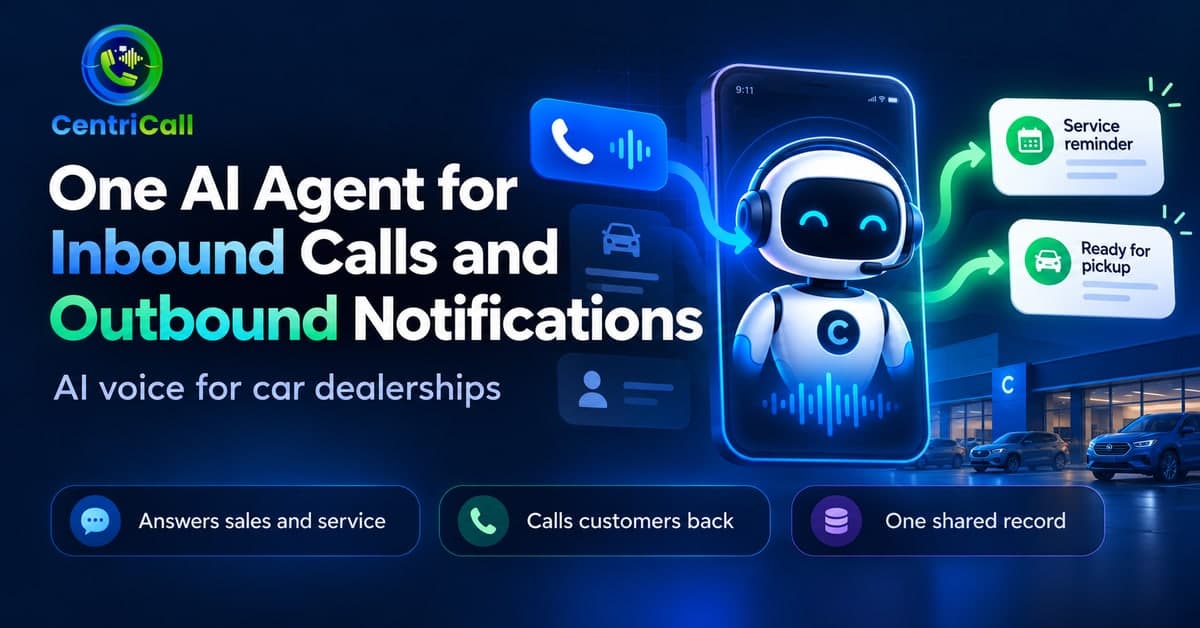
Yes, one AI voice agent can answer dealership calls and place service reminders and confirmations. Here is what to check before you choose.
Most dealerships end up with two systems for one conversation. An answering tool picks up the ringing line, and a separate dialer sends reminders. The customer sees a single store. The store sees two logs that never meet, and a reminder call that a customer returns lands on a line that knows nothing about it.
The platforms that handle both directions treat a call as one thread. This guide covers what outbound notifications a dealership actually runs, what to check when a vendor says it does both, and where the rules on outbound calling apply.
What outbound notifications cover at a dealership
- Service-due reminders: calling customers whose vehicle is due, and booking the slot on the call.
- Appointment confirmations and reminders: confirming tomorrow's bookings and rescheduling on the spot, which cuts no-shows and protects open bays.
- Ready-for-pickup calls: telling the customer the work is done so the vehicle does not sit.
- Declined-work follow-up: calling back on recommendations the customer put off at the last visit.
- Internet and showroom lead follow-up: calling a new inquiry within minutes, while interest is highest.
- Post-visit check-ins: a short call after a service or purchase to catch problems early.
Why one platform beats two
When inbound and outbound share a record, a customer who is reminded of a service and rings back is recognized, with the reminder context attached. The same agent that placed the call knows what it said. With two tools, that handoff is a human reading two screens, and it usually does not happen.
| Factor | One platform for both | Separate inbound and outbound tools |
|---|---|---|
| Customer record | One thread per customer | Two logs, reconciled by hand |
| Return calls | Agent knows the reminder | Callback lands cold |
| Scripts and rules | One set, kept consistent | Maintained twice, drift apart |
| Scheduling | Shared calendar, no double booking | Each tool books on its own view |
| Reporting | Answered and placed calls together | Stitched in a spreadsheet |
What to check when a vendor says it does both
- Shared record: does an outbound call write to the same customer record the inbound agent reads?
- Live scheduling: does it book into open bays, or send a request someone must action?
- Triggers: can outbound calls start from a service due date, a booking or a lead event without manual lists?
- Voicemail and no-answer handling: what does it do when nobody picks up, and does it retry within sensible limits?
- Opt-out handling: is a request to stop calling honored immediately across both directions?
- Handoff: when a customer asks for a person, does the transfer carry a summary?
Outbound calling has rules
Inbound calls are simple: the customer called you. Outbound is regulated. In the United States, automated and prerecorded calls fall under rules such as the Telephone Consumer Protection Act, which turns on consent, calling hours and opt-out handling. Rules differ by region and by whether a call is transactional or promotional. Treat every outbound flow as something your legal team should review, and favor vendors that build consent and opt-out into the workflow rather than leaving it to your list management.
What a day looks like with both directions
- Early morning: the agent absorbs the service-line rush, booking slots as callers ring in.
- Mid-morning: reminder and confirmation calls go out for tomorrow's appointments, with reschedules handled on the call.
- Afternoon: ready-for-pickup and follow-up calls go out as work finishes.
- Evening and overnight: inbound calls and late internet leads are captured and queued, rather than left on voicemail.
How to sequence an outbound notification
A good notification is timed and specific. A confirmation call the day before an appointment gives the customer room to reschedule, while a call minutes before gives the bay no time to refill. The same logic applies to every flow, and it is worth setting down before any list is loaded.
- Trigger: start from an event in your system, such as a due date, a booking or a status change, rather than a list someone exports.
- Timing: choose a window that fits the customer's day and the rules that apply to you, and avoid early and late hours.
- Content: say who is calling, why, and what the customer can do, in one or two sentences.
- No answer: decide whether to leave a message, text, or retry, and cap the number of attempts.
- Outcome: write the result to the customer record so the next call, in either direction, knows what happened.
Calls that should stay with a person
Automation suits the routine and the time-sensitive. It is a poor fit for conversations that turn on judgment or emotion, and a sensible setup keeps a clear route to a person for them.
- Complaints and disputes: a customer unhappy about a repair or a bill should reach someone who can decide.
- Price and trade-in negotiation: these depend on context the agent should not improvise.
- High-value or long-standing customers: flag them so a person makes the call.
- Anything the customer escalates: a request for a person is honored immediately, in both directions.
What to measure across both directions
- Answered rate: the share of inbound calls reaching an agent or a person, split by sales and service.
- Confirmation and reschedule rate: how many reminder calls end in a confirmed or moved booking.
- Appointments kept: whether no-shows fall on the days covered by reminders.
- Return-call handling: how callbacks to a notification are resolved, and how often they need a person.
- Opt-outs: a rising count is a signal that timing or content needs work.
Where Centricall fits
Centricall runs inbound and outbound from one agent, one calendar and one record. The same dealership agent that answers the service line can place service-due and confirmation calls, book into open bays and write outcomes back to your CRM or DMS. Plans start at $49 a month. If your main problem is the unanswered line, read our guide to cutting the red blinking lights on dealership phones, then use the outbound flows to protect the schedule once the line is covered.
FAQs
Can one AI platform handle both inbound calls and outbound notifications for a dealership?
- Yes. A single AI voice agent can answer sales and service calls and place service reminders, confirmations and follow-up calls. What matters is that both directions share one customer record and one set of rules.
What outbound notifications can a dealership automate?
- Service-due reminders, appointment confirmations and reminders, ready-for-pickup calls, declined-work follow-up, internet lead follow-up and post-visit check-ins are the common ones.
Are outbound AI calls allowed?
- They can be, within the consent, calling-hours and opt-out rules that apply to your business and region. In the United States that includes the Telephone Consumer Protection Act. Have your legal team review each outbound flow.
What happens when a customer returns a reminder call?
- With a shared record, the agent recognizes the customer and knows what the reminder said, so it can book or reschedule without starting over. With separate tools the callback usually lands without context.
Does it connect to our CRM or DMS?
- Outcomes can be written back to your CRM or DMS through approved integrations, and the agent books into your service calendar. Confirm the systems you use during discovery.
Should an outbound AI call say it is an AI?
- Transparency is the safer default, and some jurisdictions require it. The greeting can state who is calling and that it is an automated assistant, and a customer who asks for a person should be transferred.
What happens if the customer does not answer a reminder call?
- That is a rule you set: leave a short message, send a text, or retry later, with a cap on attempts. The outcome is logged so staff can see which reminders were not delivered.
Where should we start, inbound or outbound?
- Most stores cover the inbound line first, because that is where calls are being lost, then add confirmation and service-due reminders once booking is working. Lead follow-up usually comes last.