Global Reach
Multilingual AI Receptionist: How It Works, What It Costs and How to Test One
Nov 23, 2026
Part of multilingual AI receptionist
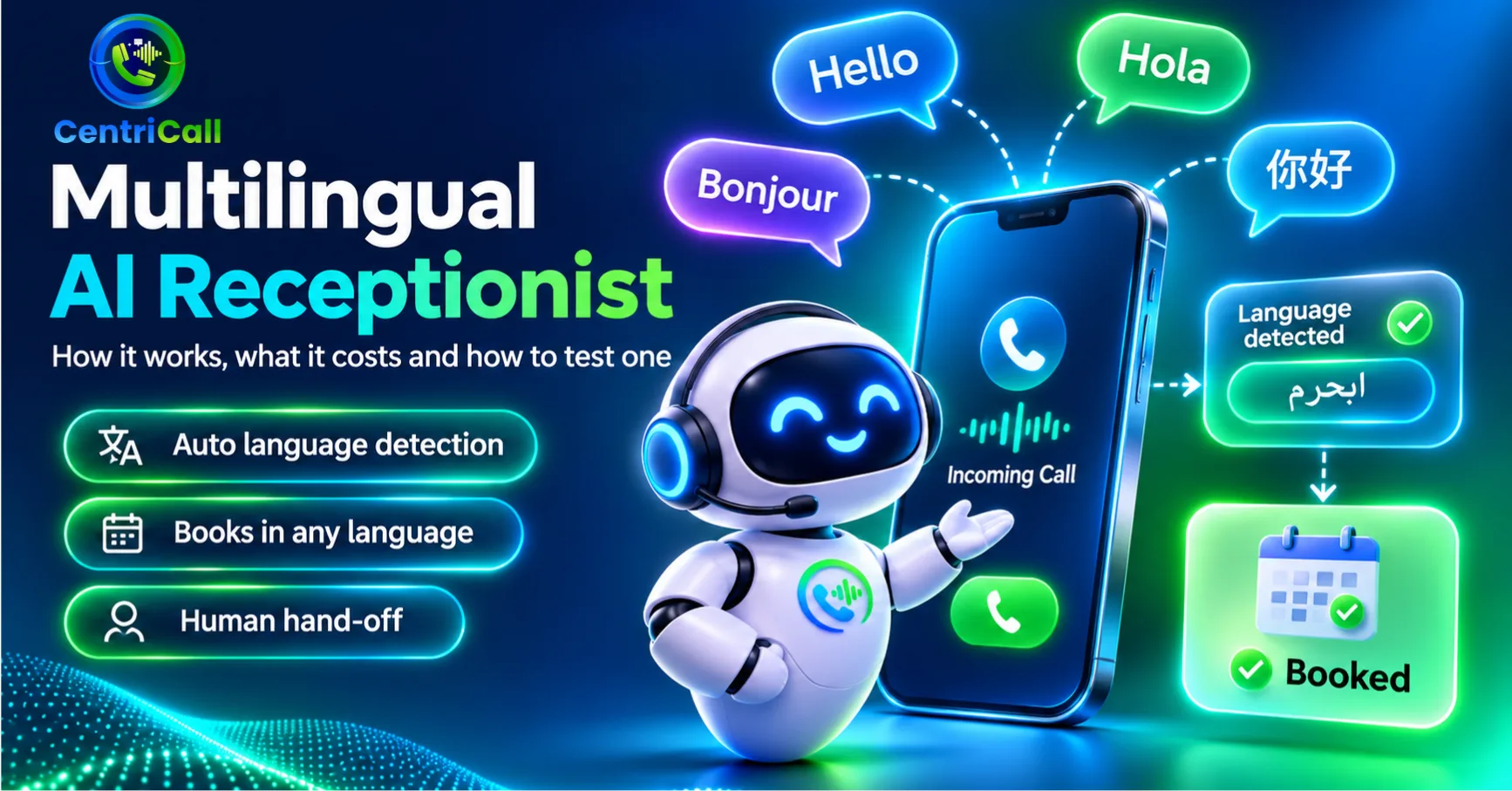
How a multilingual AI receptionist detects the caller's language, what it costs compared with a bilingual hire or a multilingual answering service, and a checklist for testing one before you buy.
If you have ever lost a call because nobody on shift spoke the caller's language, you already know the case for this. The harder question is what separates a multilingual AI receptionist that works from one that only demos well. This guide covers how it works, what it costs, which businesses benefit most and how to test one.
How a Multilingual AI Receptionist Works
The agent listens to the first words of the call, identifies the language and replies in it. There is no press-one-for-Spanish menu. If the caller changes language partway through, a good agent follows rather than locking to the greeting language. Behind the scenes it is one agent with one set of scripts, one knowledge base and one set of booking rules, so a caller in any enabled language gets the same service.
- Detection: the language is recognised from how the caller speaks, not selected from a menu.
- Conversation: the agent answers, qualifies and books in that language, using the same calendar and integrations.
- Hand-off: calls that need a person are warm-transferred with a summary, ideally to someone who speaks the language.
- Record: the call is logged as a single English summary your team can act on, whatever language it was held in.
The multilingual support page lists the capabilities in detail, and our guide to multilingual AI voice agents covers the localisation and accuracy questions behind them.
Multilingual AI Receptionist Cost
Cost depends on how the vendor charges, so compare the structure before the number. Centricall bills a multilingual receptionist the same way as any other: a monthly plan of $49, $149 or $299 with 50, 120 or 300 minutes included, then $0.15 to $0.20 per minute. Our pricing page lists the current plans.
| Option | How it is priced | Language coverage | Hours |
|---|---|---|---|
| Multilingual AI receptionist | Monthly plan with included minutes, then per minute | Every language you enable, on one number | 24 hours, every day |
| Bilingual or multilingual hire | Salary, plus cover for absence and leave | The languages that person speaks | One shift |
| Multilingual answering service | Per call or per minute, often with a monthly minimum | Whichever operators are on shift | Agreed hours; overnight cover costs extra |
The honest comparison is coverage. A bilingual hire covers one or two languages for one shift. An agent covers every enabled language for the whole clock, and hands the calls that need a person to one. Our AI vs human receptionist cost breakdown works through the arithmetic.
Who Benefits Most From a Multilingual AI Receptionist?
- Clinics and healthcare practices: patients booking in their own language, with reminders in the same one. See the healthcare industry page.
- Hotels and hospitality: guest enquiries and reservations around the clock, from callers in different time zones.
- Law firms and professional services: intake in the caller's language, with conflict screening and a warm transfer for anything sensitive.
- Home services and real estate: leads from communities your team does not speak to, captured instead of missed.
How to Test a Multilingual AI Receptionist Before You Buy
- Use real accents: call it with native speakers of each language, including the regional accents your callers actually have.
- Test your own terms: names of services, doctors, streets and products are where recognition fails first.
- Switch languages mid-call: a caller who starts in one language and gives an address in another is common, not an edge case.
- Check numbers and dates: phone numbers, spelled names and appointment times are where small errors cost a booking.
- Review the English summary: confirm it captures the same details your team would have taken down in the caller's language.
- Test the human hand-off: confirm the transfer happens, carries context and reaches someone who can continue in that language.
Recognition and synthesis are not equally strong in every language, so ask a vendor which languages they recommend for production and which are newer. Enable only the languages you have tested, and add more as you verify them.
FAQs
What is a multilingual AI receptionist?
- It is an AI voice agent that answers your phone line and handles bookings, questions and routing in whichever language the caller speaks. It detects the language automatically, so there is no menu, and it logs every call as an English summary for your team.
How much does a multilingual AI receptionist cost?
- On Centricall it follows the standard plans: $49, $149 or $299 a month with 50, 120 or 300 minutes included, then $0.15 to $0.20 per minute. Compare other vendors on how they charge for languages, and ask whether any are an add-on.
Is a multilingual AI receptionist cheaper than a bilingual receptionist?
- Usually, for coverage. A bilingual hire covers one or two languages for one shift, while an agent covers every enabled language around the clock. A person is still the better choice for sensitive or complex conversations, so most teams use the agent first and transfer when needed.
Does the caller have to choose a language?
- No. The agent detects the language from the caller's first words and replies in it, and can follow a caller who switches languages mid-call.
Is accuracy the same in every language?
- No. Recognition and voice quality are stronger in widely supported languages, and accents vary within a language. Test with native speakers and your own terminology, and enable only the languages you have verified.
Can a multilingual AI receptionist book appointments?
- Yes. It checks real availability and books into your connected calendar on the call, in the caller's language, then logs the booking in English for your team.
What happens when a call needs a human?
- The agent warm-transfers the call with a summary of what the caller needs. Plan ahead for who receives it, and ideally route to someone who speaks the caller's language.