Legal & Professional Services
Legal Front Desk Automation: What an AI Voice Agent Can Take Over at a Law Firm
Nov 2, 2026
Part of AI voice agent for law firms
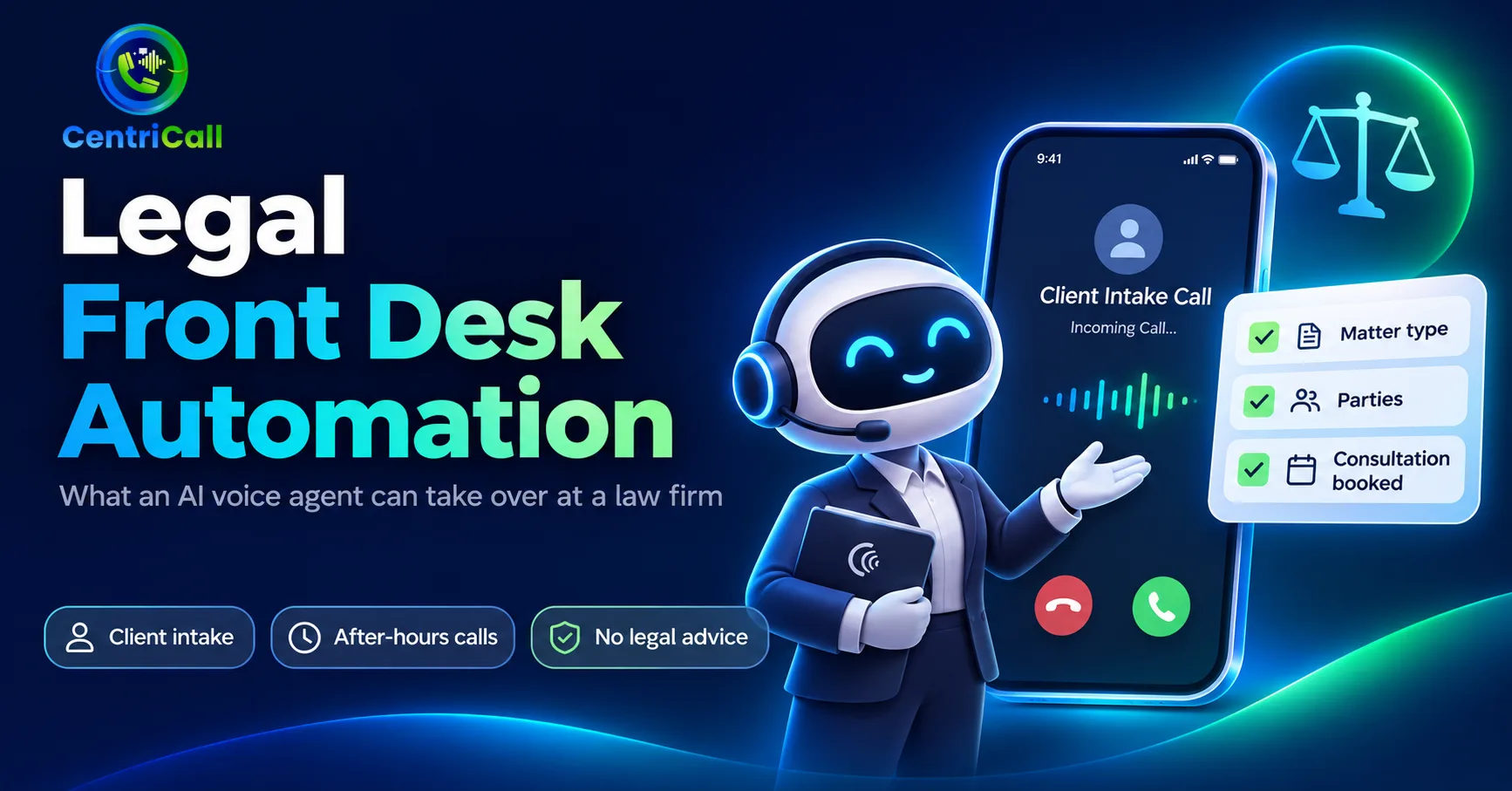
What legal front desk automation covers, which law firm calls an AI phone agent can handle, and the lines it must never cross: advice, conflicts and confidentiality.
A prospective client with a live matter rarely calls one firm. They call three and instruct whichever one answers, takes the details properly and gets a consultation in the diary. That makes the front desk a revenue function, and it is also the place where firms are thinnest: one receptionist, one line, and a phone that keeps ringing while fee earners are in meetings.
What legal front desk automation covers
The phrase covers the repetitive phone work around a firm's reception, not the legal work. AI voice agents for law firms are good at calls that follow a pattern and poor at calls that need judgment, which happens to be the line a careful firm wants anyway.
- New client intake: name, contact details, matter type, key dates and opposing party, asked in the order your intake form uses and written to the matter record.
- Consultation booking: qualified callers are booked into an attorney's calendar on the call, with a reminder before the appointment.
- Existing client calls: callers asking for an update or a named fee earner are routed with a note of why they rang.
- After-hours calls: enquiries that arrive at 9pm are answered, recorded and flagged, rather than left on voicemail.
- Appointment changes: reschedules and cancellations are handled without pulling a paralegal off a file.
What an AI phone agent for law firms should never do
The boundary matters more than the feature list. The agent gathers facts and routes the call. It does not assess a case, quote a fee outside the script you approve, or tell a caller what their rights are. A well-built agent says that plainly at the start of an intake call, and escalates when a caller asks for advice or describes an emergency such as a custody or detention situation.
Check how your jurisdiction's professional rules treat intake by non-lawyers and by automated systems, and have a partner sign off the script. Rules differ, and this guide is not legal advice.
Confidentiality, conflicts and where the data lives
Calls to a law firm contain privileged and sensitive detail from the first sentence. Ask any vendor where recordings and transcripts are stored, who can access them, and whether they are used to train models. Some firms need the whole deployment inside their own environment, and for them a private AI answering service running on their own server is the relevant option.
For conflict checks, the useful thing an agent does is capture the names of all parties at the start of intake and write them to the record, so the check can run before anyone calls the client back.
Human front desk or automated front desk
| Factor | AI phone agent | Human receptionist |
|---|---|---|
| Hours covered | Every hour, including nights and weekends | One shift |
| Calls at once | Unlimited | One at a time |
| Intake consistency | Same questions in the same order | Varies by person and by day |
| Judgment and empathy | Limited; escalates to a person | Strong |
| Languages | Detects and answers in the caller's language | Depends on who is in |
Language is a practical gain for firms serving mixed communities, because a multilingual AI receptionist can answer in the caller's language and record the intake in yours.
A rollout that keeps partners comfortable
- Listen to a month of calls: sort them into intake, existing client, admin and other before writing any rules.
- Write the intake script with a partner: the questions, the disclaimer and the list of calls that always go to a lawyer.
- Start with overflow and after-hours: the lowest-risk calls, and the ones you are losing today.
- Measure what changes: calls answered, intake forms completed and consultations booked, compared with the month before.
Centricall plans start at $49 a month with 50 included minutes, so a pilot on one practice area costs little. The AI voice agent pricing page lists all three plans and the overage rates.
FAQs
What is legal front desk automation?
- It is using software to handle the repetitive phone work of a law firm reception: answering new enquiries, collecting intake details, booking consultations and routing existing clients. A voice agent does it by phone, around the clock, and hands anything needing legal judgment to a lawyer.
Can an AI voice agent for law firms give legal advice?
- No, and it should say so. The agent collects facts and routes the call. Questions about rights, strategy or outcomes go to a lawyer.
Can an AI phone agent handle new client intake?
- Yes. It asks your intake questions in order, records the answers against the matter, captures party names for conflict checks and books the consultation.
Is it safe for confidential client calls?
- That depends on the deployment. Ask where recordings are stored, who can access them and whether they train models. Firms with strict requirements can run the platform inside their own environment.
Will it replace our receptionist?
- Usually not. Most firms use it for overflow, lunch cover and out-of-hours calls, so the receptionist can focus on visitors and the calls that need a person.
Is it worth it for a small firm?
- A small firm often loses the most from unanswered calls, because there is nobody else to pick up. Start with one practice area and compare consultations booked before and after.