Outbound & Re-engagement
AI Outbound Calling Cost: Price per Call, ROI and How It Compares With Human Callers
Nov 23, 2026
Part of AI outbound calling
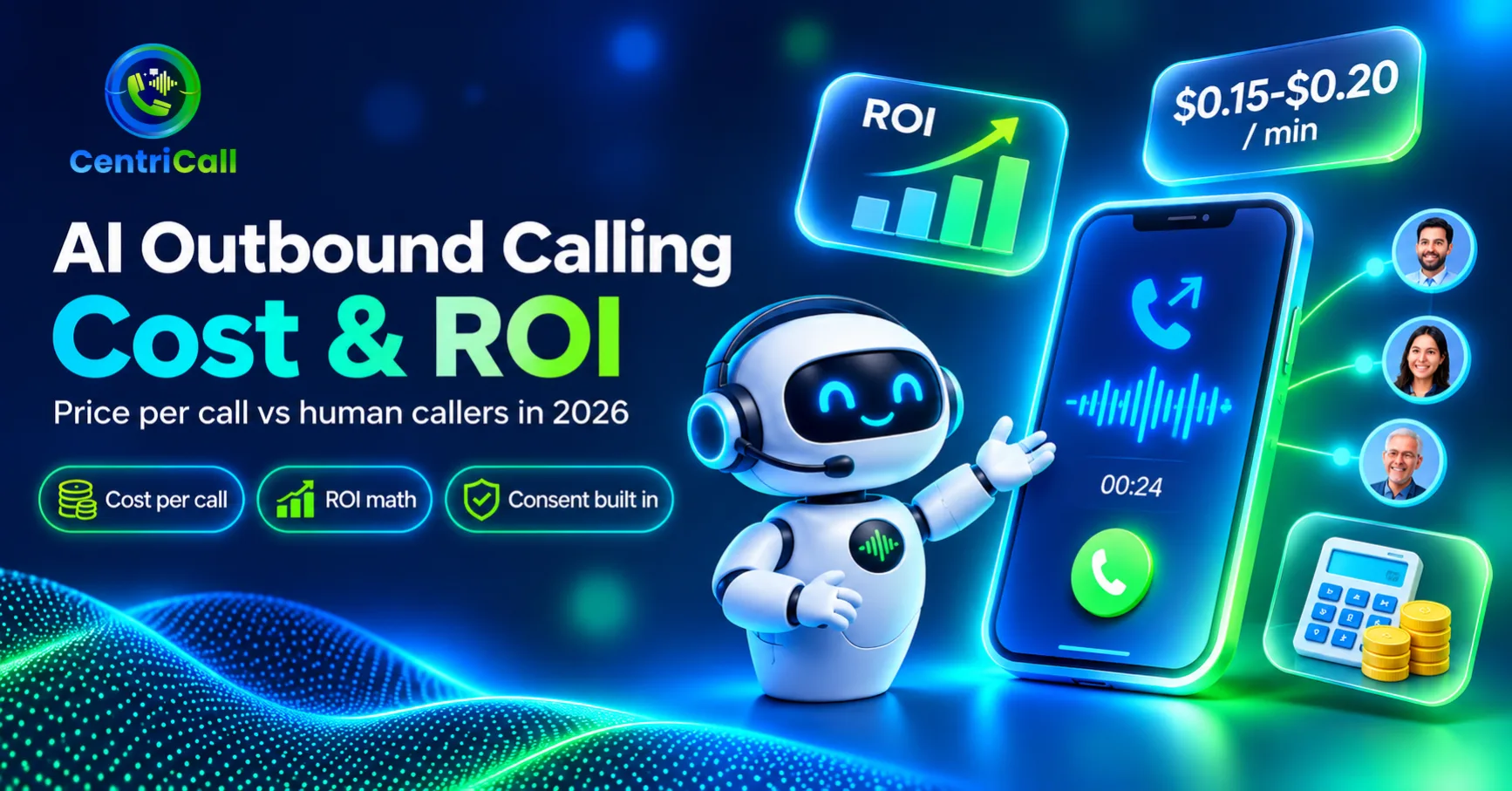
What AI outbound calling costs per call and per connected conversation, a worked ROI example against human callers, and the compliance checks to make before you launch a campaign.
Most pages about AI outbound calling explain what it is and stop before the question a buyer actually has: what does a campaign cost, and when does it pay back? This guide works through the arithmetic with numbers you can replace with your own, then covers the compliance checks that decide whether the saving is real.
What Does AI Outbound Calling Cost?
The unit that matters is not the dial but the connected minute. A voice agent only bills for time spent on a live call, so a list where most numbers ring out costs far less than the dial count suggests. Three cost lines make up the bill:
- The per-minute rate: on Centricall, $0.15 to $0.20 per minute beyond the included minutes. Developer platforms advertise lower headline figures that exclude speech, model and telephony, as our per-minute pricing guide explains.
- The plan: $49, $149 or $299 a month with 50, 120 or 300 minutes included, so a small campaign may cost nothing beyond the plan.
- Telephony and numbers: outbound caller ID numbers and any carrier charges the plan does not bundle. Ask for these in writing before you compare quotes.
Check how each vendor treats voicemail, no-answer attempts and transferred legs. Some bill them, some do not, and on a large list the difference is larger than the headline rate gap between vendors.
AI vs Human Outbound Calls: A Worked Cost Example
The figures below are illustrative assumptions, not benchmarks. Replace each with your own call log before you rely on the result.
| Assumption | AI voice agent | Human caller |
|---|---|---|
| Numbers dialled | 1,000 | 1,000 |
| Connected conversations | 300 (30 percent connect rate) | 300 (30 percent connect rate) |
| Average conversation | 2.5 minutes | 2.5 minutes |
| Time and rate | 750 minutes at $0.15 to $0.20 | About 25 working hours at an assumed $25 an hour all in |
| Cost of the campaign | $112 to $150 | About $625, before management time |
| Cost per conversation | $0.37 to $0.50 | About $2.08 |
Two things in that table are worth noticing. First, the gap is driven by the ring time and dead air a human caller sits through, which an agent does not bill for. Second, the human figure leaves out recruiting, training and the evenings and weekends you cannot staff, which is where most reminder and re-engagement calls need to happen.
When AI Outbound Calling Pays Back
The cost only matters against what a conversation is worth. Work the payback out in three steps:
- 1. Value of one outcome: an appointment kept, an invoice collected or a lead qualified. Use your own average, not an industry figure.
- 2. Outcome rate per conversation: the share of connected calls that end in that outcome. Start from your current human rate and expect the agent to differ by use case.
- 3. Cost per outcome: cost per conversation divided by the outcome rate. Compare that with what the same outcome costs you today.
Reminders, confirmations and overdue-payment nudges pay back fastest because the conversation is short and the outcome is clear. Open-ended cold prospecting is the weakest case, and our guide to how AI cold calling works covers where it is worth trying.
Compliance Checks That Protect the Saving
A cheap campaign that breaks the rules is expensive. In the United States, the FCC ruled in 2024 that AI-generated voices count as artificial voices under the TCPA, so calls that use one need the same prior consent as other automated calls, and written consent for marketing. This is a summary, not legal advice, and state rules and other countries differ.
- Consent on record: keep proof of when and how each contact agreed to be called, and honour withdrawal immediately.
- Calling hours: set windows by the recipient's local time zone, not yours.
- Opt-outs: the agent should recognise a request to stop mid-call, end the call politely and write the opt-out back to your list.
- Do-not-call lists: scrub the list against the national registry and your own suppression list before every campaign.
- Disclosure: have the agent identify itself and your business at the start of the call.
Centricall campaigns respect opt-outs and the calling hours you set, with outcomes written back to the contact. The inbound and outbound calls feature page shows how that works on a live call.
How to Pilot AI Outbound Calling Without Overspending
- Start with one list and one outcome: for example confirming next week's appointments. A narrow pilot gives a clean cost per outcome.
- Cap the minutes: stay inside a plan allowance so the pilot has a fixed ceiling.
- Listen to the first 50 calls: fix the script before you scale. Most early problems are wording, not technology.
- Measure cost per outcome, not cost per call: a cheap call that achieves nothing is the most expensive kind.
- Scale in steps: double the list only after the outcome rate holds.
FAQs
How much does AI outbound calling cost per call?
- On Centricall, a connected call costs $0.15 to $0.20 per minute beyond the plan's included minutes, so a typical two and a half minute conversation costs roughly $0.40 to $0.50. Calls that ring out or reach voicemail cost far less, and you should confirm how each vendor bills them.
Is AI outbound calling cheaper than human callers?
- For short, structured calls such as reminders, confirmations and follow-ups, usually yes, because an agent does not bill for ring time, breaks or evenings. For long, sensitive or negotiated conversations a human is often the better choice, and many teams use an agent first and transfer to a person.
What is the ROI of AI outbound calling?
- Divide the cost per conversation by the share of conversations that end in the outcome you want, then compare that cost per outcome with what you pay today. Reminders and payment nudges tend to pay back fastest because the outcome is clear and the call is short.
Do I need consent to run AI outbound calls?
- In the United States, the FCC has ruled that AI-generated voices are artificial voices under the TCPA, so calls need prior consent, and written consent for marketing. Rules differ by state and country, so take legal advice for your market before you launch.
Are voicemails and no-answer calls billed?
- It depends on the vendor. Some bill the time an agent spends on voicemail, and some bill transferred legs separately. Ask for this in writing, because on a large list it can matter more than the headline per-minute rate.
How do I start an AI outbound calling pilot?
- Pick one list and one outcome, keep it within a plan's included minutes, listen to the first 50 calls and fix the script before you scale. Measure cost per outcome rather than cost per call.